


Spoilers for A Real Animal follow. This post contains mentions of sexual assault and domestic violence.
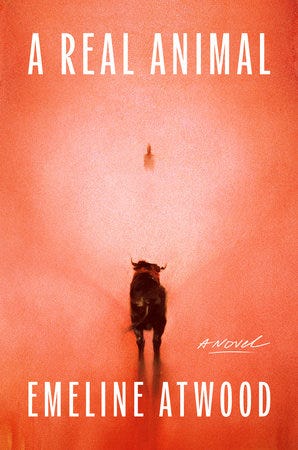
A Real Animal is the best debut I’ve read in 2026. It’s an epic coming-of-age story mapped over a woman’s twenties. It’s about the aftermath of a sexual assault and how that kind of experience fractures the relationship with the self, so that rebuilding it becomes the hard labor of many years. Atwood is a writer committed to exposing every aspect of personhood, whether it’s primal or refined. To read her novel is to be startled out of the numbness of modern life, to be devastated and grateful for the devastation. Last week, it deservedly made the shortlist for The Center for Fiction’s First Novel Prize.
How would you describe Lucy’s relationship with her body?
I used to think about the book in the context of exploring what it’s like to be in a traumatized body. Lucy doesn’t feel like she belongs in her own body anymore. I think she has a lot of conviction around the need to survive and move forward. She resents the way that the rape has made her body no longer inhabitable to her. That’s part of what contributes to the hallucination around the leopard. The leopard’s body is another body for her to be in where she can feel fully embodied without it being her body. What really unlocked the book for me was thinking about it more episodically. I’d been reading a lot of Ursula Le Guin’s essays and “The Carrier Bag Theory of Fiction” really resonated with me. But when someone brought up The Odyssey to me this summer, I did like that way of framing Lucy’s story. Her journey is a little bit of an odyssey because she starts at home, goes out into the world, and returns home. This is to say that the body represents a certain kind of home. Part of Lucy’s journey back home is her journey back into her body after having experienced this thing that has separated her from it. What I was encountering a lot this summer was that some readers found the book very disturbing and visceral. That was surprising to me, but I’ve come to a peaceful relationship with that description because I do think the book is about feeling what it’s like to reclaim your body in all its extraordinary senses and its capacity for feeling. If readers are feeling the book in their bodies, it means to me that they’re connecting with Lucy in some way.
Do you feel like readers saying the book was violent was a critique?
That description of the writing made me concerned that it was gratuitous, manipulative, and graphic, which isn’t my intention. I think the book can be off-putting because of the visceral content.
I didn’t think it was gratuitous at all.
Thank you. Someone mentioned the scene where Ellis pulls Lucy’s hair being violent. That’s obviously a violent thing to do, but there’s so much violence in the world. There’s no blood or broken bones in that scene. Obviously, the violence is very felt. The scene where Lucy hallucinates Liam’s dad raping her has also given me a lot of grief. Some people read that as if it actually happened, which makes me feel really guilty. I hate the idea that Liam’s dad has to carry that idea in the mind of some readers. The book is about inhabiting this kind of consciousness that is capable of imagining herself into a leopard. Her hallucinations are high-stakes and dangerous. They can send her a hundred feet up into a tree. I think some readers were saying that they misinterpreted it because they were reading that scene very fast and just wanted to get through it. Something about the dialogue in that scene is very disturbing, but the rape that she’s hallucinating isn’t depicted that physically.
I think that scene gives the reader a sense of what it’s like to be so paranoid and on guard all the time as if someone is going to hurt you, so it felt necessary to me.
I appreciate that. I was trying to create this parallel between that chapter and the open water chapter because Lucy’s with another boyfriend at a lake as opposed to a boyfriend at the ocean. There’s an old man in both chapters. This is the way that trauma can reverberate and reappear. It made sense that this trauma comes back to her when she’s in a family environment with a boyfriend, concerned that she doesn’t belong there. The last time she took a trip was with Ellis to Maui and there was an old man there, too. I think she feels like she needs to be concealing or suppressing parts of herself in order to belong. That degree of suppression comes out in this horrible hallucination. Every other trauma that does happen in Lucy’s physical reality does come back, though. She talks about the miscarriage with her mom. She talks about the rape with Ellis. She never talks about the Liam’s dad incident again because she recognizes that it wasn’t real. I was hoping that the reader would trust the story enough to know that if this wasn’t a hallucination, it would have needed to have some kind of resolution, which it doesn’t.
How did your expectations of putting the book out compare to the reality?
It’s so wild. It’s such a long birthing process. This book has been coming out for years for me. I was writing it and then I was editing it. Then, it comes out and I’m back at home. It feels like it has nothing to do with me anymore. The minute the book comes out, it’s officially no longer mine. You have to detach. The way that I want to be encountering people’s responses is from a position of fellow reader as opposed to writer/creator because then you become protective. A lot of people don’t find Lucy likable, which is something that I think a lot of writers deal with. Lucy is a frustrating character, but I obviously love her because I created her.
I heard that you said that she’s a character who’s capable of murder. Can you say more?
I wanted the book to embrace the idea that to be an animal is to be human and to be human is to be an animal. We spend a lot of time, especially in this day and age, trying to differentiate between what is human and what is not. I think instead the question is: What does it mean to be a human type of animal? Humans are capable of lying and telling secrets. We may be the only animals that tell secrets and lie. Our unique human nature also enables us to imagine and create and fictionalize. Imagination and psychosis and secrecy and deceit are all different sides of the same die. They’re all working in the world of make believe. That’s part of the gorgeous and dangerous nature of being human. I think we spend a lot of time in this mindset of punishment and othering. I think a lot of times fiction is trying to ask, how are other people actually like you? In fiction, you’re writing what you’re scared to know about yourself. Could I imagine being Ellis? Do I have empathy for someone that’s abusive? Where is his vulnerability? That’s the risk of fiction. Ursula Le Guin writes about this in her essay, “Why Are Americans Afraid of Dragons?”. We are afraid of our ability to imagine horrible things and things that make us long to be outside our own lives. We’ve seen that humans are capable of murder throughout all of human history. Some people that murder are maybe not that different from us, actually. I think some people have read the book through a somewhat limiting feminist lens, thinking that it’s about what it’s like to be a woman in a world of dangerous men. I saw the book as being deeper, about what it’s like to be a human in a dangerous world. Being traumatized opens you up to your capacity for survival. Sometimes those instincts are predatory ones, but maybe they’re essential for survival. Can we get outside of a moralizing frame?
“In fiction, you’re writing what you’re scared to know about yourself.”
Emeline Atwood
Did you think about situations where Lucy would be driven to that extreme?
She does leave Ellis in the ocean. Some readers have had trouble with that scene and see it as an act of murder. Others see it as a crucial act of triumph and empowerment. That textures all of human history: war, conquering, the hero’s journey, Odysseus. Murder and triumph are so tied together.
I didn’t see it as predatory, because he abandoned her first.
That’s how I see it. He was trying to pull her down. In all of part one, Lucy is trying to find a way into her body. Having sex with countless men over and over again is her misguided attempt to wake her body up and reclaim it. What actually reattaches her to her body is scuba diving: the quiet and the depths of the ocean. She was only able to leave Ellis underwater. It’s underwater that she finds power in herself. She finds this tremendous sense of alignment in her mind and body.
So the diving gives her the strength to leave him?
I think so. Part one is bookended by being in the tremendous height of the tree as a leopard, then it moves into the ocean. She descends from the tree and then ascends from the depths. I listened to a Jorie Graham interview the other day. She said something like, “the word ‘human’ grounds us in the earth”. We come from dirt and we go back to dirt. What Lucy needs to claim again is her humanity. She needs to reincarnate herself into herself. She needs to be in her body, not the body of the leopard or of the fish. I think “breaking point” is not an empowering enough term for the feeling that Lucy is having when she decides to liberate herself. I think she is finally flying out of this relationship.
Was Ellis a difficult character for you to write? Who was the most challenging for you?
The most challenging character was the mom. I really feel like I understand Ellis. He breaks my heart, even though people absolutely hate him and I understand that. Ellis does offer Lucy some things. He is obviously abusive and violent, but he also offers her a way to shed her shame. That’s the first thing that he does for her. He tells her that she’s not a bad person for cheating on her boyfriend, that what matters is that she’s free and happy. Some of the things he says to her continue to reverberate as important tenets of her life. I do believe that he really loves her, which doesn’t make up for the abuse. But he is a human being, not just a monster.
Yes, he tells her how smart she is.
He is kind of in awe of her in different moments. He’s not holding all of the power. He says from the beginning that he knows Lucy is going to leave him. He can’t even look at the picture of her parents too long because she has parents and he doesn’t. They only interact in territory that’s neither of theirs. That’s not the case with Lucy’s other relationships. Lucy is only in Liam’s habitat. We see Cole only in Lucy’s habitat. There’s something very aggravating to Ellis about the idea that he’s a tourist and doesn’t belong. Lucy also wants to belong.
Can you tell me why the mom was the trickiest for you to write?
I used to have this theory that you can enter into any piece of fiction by asking, “where is the mother?” That’s the same as asking “where is home?” A mother figure in a book is going to hold a tremendous amount of gravity, whether she’s physically there or not. When I revised this book, it ended up being 650 pages, twice as long, and it became dominated by the mother. The trick with the mother was finding the right amount of space for her in the book. She needed to be present enough because Lucy’s relationship with her mom is so critical. There’s a lot of trauma that Lucy is inheriting from her mother. Because I wrote so much into the mom, I have a very full picture of her life in my head. I wrote so many journal entries for her, through her eyes and through her voice. It became an intense process of selection. I have a hard time talking about the mom and the sister, Patty.
Is that because you know them so well and it’s difficult to summarize them?
There’s something self-explanatory about sisterhood and motherhood in this book that Lucy contends with. She’s worried that it isn’t durable, but it is. Her mom and her sister love her. Even though Patty doesn’t really love being around Lucy, she still loves Lucy and doesn’t want to be estranged from her. It’s hard for me to articulate beyond the self-explanatory nature of family.
Do you think she comes to an understanding about her family by the end?
I think she does, but I don’t think that understanding actually wards off loneliness. Being known by somebody doesn’t mean you’re not lonely. There’s an asymptotic effect to intimacy. There’s always some distance between two people. Patty says to Lucy, “you just have to be good with yourself.”
“Being known by somebody doesn’t mean you’re not lonely. There’s an asymptotic effect to intimacy.”
Emeline Atwood
I kept thinking the book would end in a traditional or happy place. How did you conceive of the ending?
When we went on submission with this book, a few of the editors wanted a traditional happy ending, as in Liam and Lucy would end up together. They also wanted the leopard to come back. I knew that this book was following a different logic. That being said, I did play around with a version of this book where Liam and Lucy ended up together. I don’t think that’s a happy ending for either of them, actually. I don’t think Liam is the right partner for Lucy. The marriage plot is the happy ending that we’re used to, but Lucy’s happy ending might actually be being able to wander in the snow through the woods alone and be good with herself. Maybe that’s where she’s meant to arrive. There have been times when I’ve found the ending very sad and other times when I’ve found the ending more peaceful. Because this book deals with the realm of unreality, I needed to be very careful with ambiguity. To me, ambiguity in the Liam’s dad scene is not actually productive. I wanted every reader to know that it was a hallucination. I hope that the book earns the ambiguity by the end. I let myself fall into that ending, which is a little big magical and ambiguous. It’s a merging of reality and unreality. I wanted to arrive in a place of the present tense, where we’re feeling the snow on our eyelashes and the cold in the air and we’re looking at the birds.
I loved the last line in particular: “Someone will witness it.” I can see her being good with herself but also yearning for other people, which is honest.
I was writing this from a place of fear, not wanting to end up like Lucy. I was writing it in my twenties, where you don’t know if you’ll find partnership or a home in the world. You’re confronting your mortality because you realize that the decisions you make are permanent. I chose to go to grad school in Austin. I met my fiancé in Austin. Choosing Austin over Iowa or NYU has consequences. Making choices liberates you and I’m so grateful that this is where I am, but there is so much terror as you start coming into adulthood.
Can you talk about how you wrote the endings of every chapter? I loved how they felt a little divorced from the action.
When I was writing this book, the first image that came to me was the leopard, which came to me when I was scuba diving. Scuba diving rescued me at that time of my life because it made everything so quiet. I didn’t know where I was supposed to place this novel in the classical arc, because it didn’t feel like Lucy’s story was a story of aftermath. It also doesn’t feel like the leopard is a climax. It’s just one moment of transformation in a life that has many transformations, big and small, and many traumas, big and small. Maybe the point is finding the narrative that is connecting them, that rises and falls intermittently. It would be so beautiful if we had a single narrative to explain who we are, but we all contain so much. The trauma of Liam’s nephew not wanting to hug Lucy is traumatizing her. It’s a small trauma, but still. So, I needed a form in which the weight could be distributed more evenly and I wanted all the chapters to have their own individual nexus. When I was able to embrace that more elliptical, episodic structure, it allowed me to follow a more poetic logic. I read more poetry than fiction. When I was trying to find the satisfying end of a chapter, I thought about the different kinds of logic it was following. Traditional resolution can feel contrived and unreal in a lot of ways. I wanted the chapters to end in a moment of evolution rather than resolution, gesturing out instead of closing in. Sometimes, an image or something that feels out of place can grant unexpected closure. It was sometimes organic and sometimes a process of selection.
“It would be so beautiful if we had a single narrative to explain who we are, but we all contain so much.”
Emeline Atwood
I think one of my favorite images was when Lucy was thinking about wanting to be old, to have gained the knowledge from “learning the same lessons over and over.” What do you think she has to learn?
I think Lucy has an anxiety around achievement and being extraordinary. That’s something you contend with in young adulthood, the size of your life. Ultimately, that question might be misguided. How do you even measure the size of a life? I think she says that she doesn’t want to be in a place where she’s looking back instead of looking forward. She’s worried about looking back and being upset with who she was. I’m terrified of aging.
That’s human.
Exactly. A huge mark of our collective immaturity is looking for these hacks to be immortal, to shortcut our way of our decay over time. Maybe the mark of maturity is being able to embrace that fully. I do think you can come of age at any age in your life. I do think Lucy is starting to see the full arc of things, which is very scary to confront. Ultimately, no one’s life is enormous. What is the point of accumulating all this knowledge at the end of your life when you’re going to die? I’ve been having this preoccupation about the difference between knowledge and information-gathering. The confusion between those two things is a big issue these days. Knowledge is very much rooted in presence and attention, rather than recitation or regurgitation.
There’s a conversation toward the end of the book where a few girls are saying to Lucy that narratives about rape victims are tiresome. I was wondering if you struggled with writing this novel for that reason.
I struggled with that scene. There are as many stories about women being raped as there are women who have been raped. You can’t make a rule about how many of those stories are allowed. Then, you have to hold the truth that society tends to publish stories about the lives of those in power. The stories of rape that are represented are typically those of young, pretty, privileged, white women. Lucy’s story is one of those stories. I think the girls in that scene are regurgitating the thesis that different stories should be represented, which has credence to it. What do you think?
I’ve struggled with that question myself. I’ve thought about people dismissing certain novels as “#MeToo novels.” I wondered if you had to consciously craft Lucy as an active subject. She’s animalistic. She’s not passive. She’s not a victim. Did you have that on your mind as you were shaping her character?
Lucy is just Lucy to me. That is who she is. My job is being able to write her story and do it justice. I think of writing as more of an archaeology project, where you’re digging into someone’s life. You have to make the choice of what artifacts you’re going to exhibit and what you’re going to cover up. That feels so different from the mindset of what books we’re going to publish and promote. My purpose is just to write this book. Of course, I had anxieties around this. I worried that people would be tired of another trauma plot novel. All of that is interference with the process, though.
Can you talk about Lucy and Liam’s relationship more? Why do you feel like he isn’t the right partner for her?
Lucy lies. Sometimes, people can accept that kind of dishonesty. Liam takes a lot of pride in the physical, tangible world. He doesn’t mess around in the illusory, dream-like space. Liam’s space ultimately isn’t the right home for Lucy, either, because she’s aware that there are parts of her that Liam doesn’t like. She hides those away from him. She’s right because Liam doesn’t want to acknowledge the things about her that he finds scary. It’s important to be with someone that accepts and loves you now, without a contingency. At the end of the day, you stay together when you continue to choose each other.
The subject of cheating comes up repeatedly. He’s appalled by her cheating, whereas Ellis accepts it.
Exactly. Lucy did feel seen by him in important ways. In other ways, she was doing things that were not in alignment with what she wanted. She was staying in a relationship that was dangerous to her.
I know that you talked about writing this while you were sleeping. What’s creatively stimulating about that for you?
Fiction is make-believe. I write in my head a lot, then write it down in my notes. Sitting down at a laptop is a tiny portion of my writing process. That’s the end of the generating stage. Revising is a different beast. The times I write the most is when I’m sleeping, driving, biking, diving, walking my dog without my phone. Whenever I’m super present, I start to daydream. The stuff that comes to me when I’m sleeping is always pretty good stuff because it’s textured with the loosening of the subconscious.
“The stuff that comes to me when I’m sleeping is always pretty good stuff because it’s textured with the loosening of the subconscious.”
Emeline Atwood
How do you remember? Do you immediately write things down?
I definitely do that. I write into the Notes app of my phone. I had a teacher, Elizabeth McCracken, who always talked about bringing more bodies into stories. My friends and I thought she meant literally describing bodies, but description is not embodiment or imagination. Bringing bodies into the work means that you are imagining being in the body of the character who is experiencing this thing. I can picture the make-believe games I would play with my sister and brother as a child. I don’t need to remember what happened because we were living it in our bodies. That’s a much stronger force in childhood, but there’s something that’s close to that that enables me to remember the scenes I’m imagining. It’s not the literal language.
I heard you climbed trees to remember what it was like to climb a tree.
Did I? Probably. I loved climbing trees as a kid. If I don’t know how to unstick a scene, I close my eyes and pretend. That feels very easy to do when you’re asleep or dreaming.
How did you balance this with your day job?
It’s challenging. I work in tech marketing. It’s 9-5 and remote, so I have flexibility over my schedule. The work culture is great. It’s so hard to write a book and sell a book, though. The amount of space it takes in your brain is tremendous and exhausting. I’m not someone that writes every day. When I need to write, I prioritize it. When I was writing this book, I was waking up at 6am and writing it before work.
Have you started your second book?
I have. It’s happening in my head, which feels great. I’m at the point where I need to sit down and get it into a Word doc, but I haven’t been able to find the time. I do think that it’s helpful to have a salary that’s detached from the writing. The feeling of hustling isn’t conducive to my writing.
How did you decide that your first novel was finished?
People will say that you should send it out to agents when you think the book is done. I think it’s about not being able to take the book further. I sent mine out when it was not much. Getting agent interest was what motivated me to work on it more. After I signed with my agent, I worked on it for a few more months before we sent it out. Every time you think it’s done, there’s another round of revision. Even in this book, I wanted to rewrite the Liam’s dad scene.
Really? What would you add or take away?
There needs to be something in the physical reality of the world that confirms it’s a hallucination. I thought I had put in a geographical impossibility with Liam’s dad arriving with donuts. I realized that I didn’t make the setting clear enough for that to be a geographical impossibility in the mind of the reader. I wanted to rewrite it so that Liam’s dad wasn’t actually there. He would have gone home from the lake to go back to work. That would have made sense because Liam had dad issues, since his dad was never around. So, that would have given more information about Liam’s relationship with his dad and made it clear that his dad wasn’t physically there. I could have also indicated that with the dialogue earlier in the chapter. That sequence used to be about Richard, the old man in Maui. Making it about Liam’s dad was a decision I made to make it feel higher stakes. It was always a dream sequence in the mind of me and my editor, so maybe we weren’t realizing that people would misinterpret it.
Learn more about Emeline and her work:
https://www.emelineatwood.com/